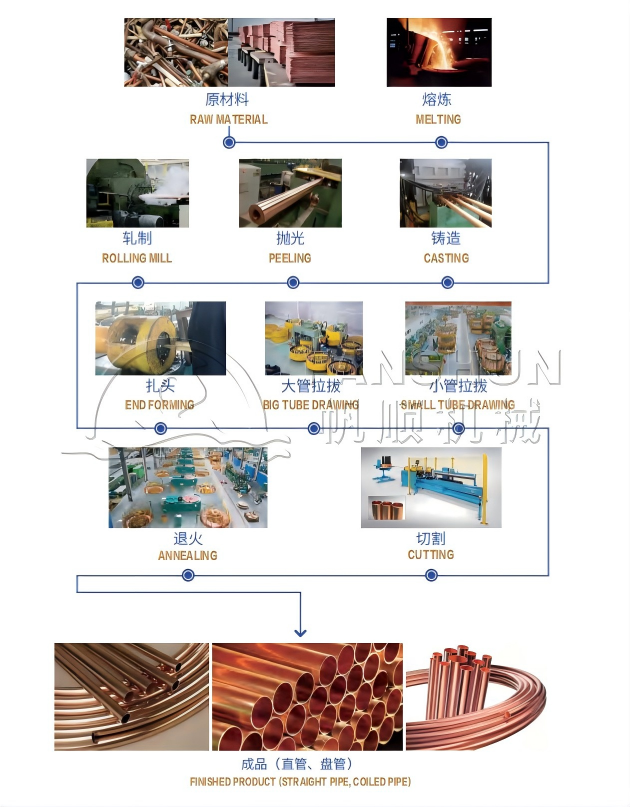
What Are the Advantages of Horizontal Continuous Casting for HVAC and Refrigeration Copper Tubes?
In the manufacturing of high-precision air conditioning copper tube, refrigeration copper tube, and HVAC copper tube, manufacturers always face a core choice between horizontal continuous casting production line and upward continuous casting technology. As the global HVAC and refrigeration industry upgrades product efficiency and quality standards, the performance gap between horizontal continuous casting production line and traditional upward continuous casting becomes increasingly prominent, making the selection of casting processes a key factor determining the quality and market competitiveness of air conditioning copper tube, refrigeration copper tube, and HVAC copper tube products.
First of all, the horizontal continuous casting production line delivers far better production flexibility than upward continuous casting for manufacturing diverse air conditioning copper tube, refrigeration copper tube, and HVAC copper tube specifications. The horizontal continuous casting production line adopts a horizontal molten metal feeding and traction structure, which allows rapid replacement of graphite crystallizers and flexible switching of tube diameters and wall thicknesses. In contrast, upward continuous casting features a fixed vertical casting structure with cumbersome mold replacement, which cannot adapt to the multi-specification and small-batch production demands of modern air conditioning copper tube, refrigeration copper tube, and HVAC copper tube production. Most HVAC component manufacturers need customized HVAC copper tube and refrigeration copper tube products, and the horizontal continuous casting production line perfectly meets this personalized production demand, while upward continuous casting is more suitable for single-specification mass production with poor product compatibility.
In terms of product quality stability, the horizontal continuous casting production line outperforms upward continuous casting in producing high-quality air conditioning copper tube, refrigeration copper tube, and HVAC copper tube. The horizontal feeding mode of the horizontal continuous casting production line avoids molten copper turbulence and splashing caused by vertical suction in upward continuous casting, effectively reducing internal defects such as pores, slag inclusions, and uneven grain structure in air conditioning copper tube, refrigeration copper tube, and HVAC copper tube. The horizontal continuous casting production line ensures uniform cooling of copper blanks in all directions, making the wall thickness uniformity and mechanical properties of finished HVAC copper tube and refrigeration copper tube far more stable than those produced by upward continuous casting. For air conditioning copper tube used in high-precision heat exchanger systems, the low-defect advantage of the horizontal continuous casting production line can significantly improve the pressure resistance and service life of pipe fittings, a performance that upward continuous casting cannot fully achieve.
Production efficiency and yield are another core advantage of the horizontal continuous casting production line over upward continuous casting for air conditioning copper tube, refrigeration copper tube, and HVAC copper tube manufacturing. The horizontal continuous casting production line supports continuous and uninterrupted casting production with a stable traction speed, greatly improving the hourly output of HVAC copper tube and refrigeration copper tube blanks. The material yield rate of the horizontal continuous casting production line for air conditioning copper tube production is 3%–5% higher than that of upward continuous casting, reducing raw material waste and production costs. Meanwhile, the fully automated control system of thehorizontal continuous casting production line minimizes manual intervention, lowering the error rate in air conditioning copper tube, refrigeration copper tube, and HVAC copper tube production. In comparison, upward continuous casting requires frequent parameter debugging during production, with unstable traction speed that easily causes dimensional deviation of HVAC copper tube and refrigeration copper tube, resulting in low yield and repeated rework.
In terms of equipment operation and maintenance, the horizontal continuous casting production line is more suitable for long-term batch production of air conditioning copper tube, refrigeration copper tube, and HVAC copper tube than upward continuous casting. The structural layout of the horizontal continuous casting production line is flat and intuitive, making daily inspection, mold replacement, and equipment maintenance more convenient. The cooling water system and traction mechanism of thehorizontal continuous casting production line run stably with low failure rates, ensuring continuous production of HVAC copper tube and refrigeration copper tube. In contrast, the vertical structure of upward continuous casting leads to concentrated equipment stress, vulnerable core components, and high daily maintenance costs. For medium and large copper tube factories focusing on air conditioning copper tube and HVAC copper tube mass production, the horizontal continuous casting production line can effectively reduce downtime and improve overall production efficiency, while upward continuous casting often delays production progress due to frequent equipment failures.
Energy saving and environmental protection are also prominent strengths of the horizontal continuous casting production line in air conditioning copper tube, refrigeration copper tube, and HVAC copper tube production. The optimized melting and cooling system of the horizontal continuous casting production line reduces heat loss during copper liquid casting, cutting unit energy consumption by about 8% compared with upward continuous casting. The closed casting environment of the horizontal continuous casting production line avoids copper liquid oxidation and splashing pollution, ensuring the surface finish of HVAC copper tube and refrigeration copper tube while meeting global environmental production standards. Upward continuous casting has higher heat loss and oxidation risks during vertical casting, which not only increases energy consumption but also easily causes surface oxidation defects on air conditioning copper tube, affecting the subsequent rolling and processing quality of HVAC copper tube products.
In terms of downstream processing adaptability, air conditioning copper tube, refrigeration copper tube, and HVAC copper tube produced by the horizontal continuous casting production line have better ductility and processing performance than those fromupward continuous casting. The uniform grain structure of copper blanks from the horizontal continuous casting production line enables smooth cold drawing, rolling, and flaring processing of finished HVAC copper tube and refrigeration copper tube, with extremely low processing scrap rate. Upward continuous casting produces copper blanks with uneven internal structure, which are prone to cracking and deformation during the deep processing of air conditioning copper tube, restricting the product’s application in high-end HVAC refrigeration equipment.
To sum up, when producing high-quality air conditioning copper tube, refrigeration copper tube, and HVAC copper tube, the horizontal continuous casting production line has comprehensive advantages over upward continuous casting in product flexibility, quality stability, production efficiency, operation cost, energy saving, and downstream adaptability. As the HVAC refrigeration industry pursues higher precision and lower cost, the horizontal continuous casting production line has gradually become the mainstream equipment for air conditioning copper tube and HVAC copper tube production, replacing the traditional upward continuous casting process and bringing more reliable product quality and higher economic benefits to copper tube manufacturers.