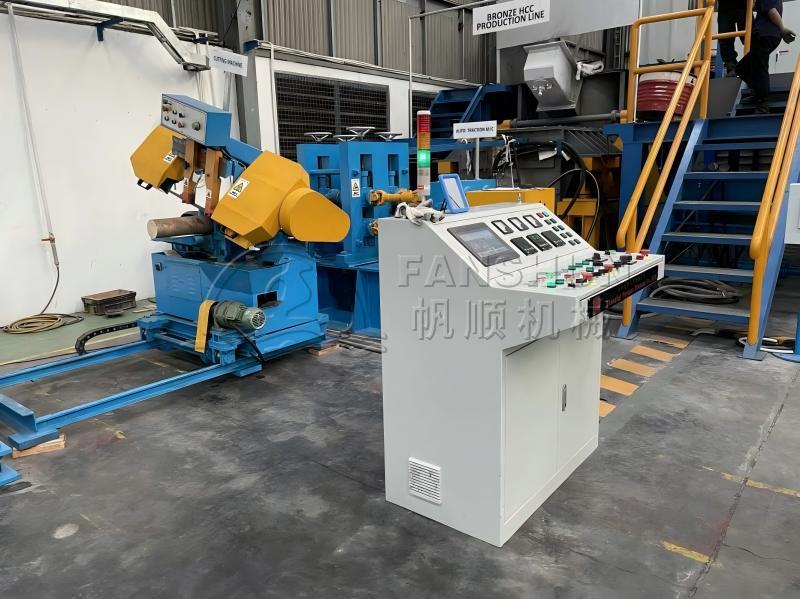
Which High-Grade Alloys Are Suitable for Vacuum Continuous Casting Lines?
1. Introduction: The Growing Demand for High-Grade Alloy Casting
With the continuous development of advanced manufacturing, aerospace, electronics, automotive engineering, medical equipment, and precision machinery, the demand for high-performance metal alloys is increasing rapidly. Manufacturers are paying greater attention to material purity, structural uniformity, mechanical properties, and casting consistency.
Traditional casting methods may struggle to meet the increasingly strict requirements of certain high-grade alloys, particularly those that are sensitive to oxidation, gas absorption, and impurity contamination.
This is where a Vacuum Continuous Casting Machine becomes an important manufacturing solution. By controlling the atmosphere during melting and solidification, vacuum continuous casting technology helps manufacturers produce high-quality metal rods, billets, bars, strips, and other semi-finished products.
Depending on the material characteristics and production requirements, an Inert Gas Protected Casting Machine or a Semi-Continuous Casting Machine can also be considered.
So, which high-grade alloys are suitable for vacuum continuous casting lines? Let's explore the most important material categories and their processing requirements.
2. High-Grade Alloys Suitable for Vacuum Continuous Casting
2.1 Oxygen-Free Copper and High-Purity Copper Alloys
High-purity copper is widely used in electrical engineering, power transmission, electronic components, and high-frequency applications.
Oxygen-free copper requires strict control of oxygen content and other impurities. During conventional melting and casting, exposure to atmospheric oxygen can negatively affect the final material properties.
A Vacuum Continuous Casting Machine provides a controlled processing environment that helps reduce oxidation and gas-related defects.
Typical applications include:
High-purity copper rods and billets.
Oxygen-free copper bars.
Electronic and electrical conductors.
High-conductivity copper components.
For manufacturers processing oxygen-sensitive copper materials, a Vacuum Induction Melting Furnace can provide effective melting conditions before continuous casting.
2.2 Copper-Chromium and Copper-Zirconium Alloys
Copper-chromium and copper-chromium-zirconium alloys are important high-performance materials used in resistance welding electrodes, electrical contacts, conductive components, and industrial equipment.
Common grades include:
C18200: Chromium copper.
C18150: Chromium zirconium copper.
CuCr1 and related copper-chromium alloys.
These materials combine good electrical conductivity, high strength, and excellent thermal performance.
Their production requires accurate alloy composition control and uniform distribution of alloying elements. A Vacuum Induction Melting process can help control the melting environment and reduce contamination.
For these applications, a Vacuum Continuous Casting Machine can be designed according to the alloy composition, billet diameter, production capacity, and downstream processing requirements.
2.3 Nickel-Based Superalloys
Nickel-based superalloys are widely used in aerospace engines, gas turbines, power generation, and high-temperature industrial equipment.
Typical materials include Inconel 718, Inconel 625, and other nickel-based heat-resistant alloys.
These materials contain different combinations of nickel, chromium, molybdenum, iron, niobium, and other alloying elements.
Their casting requirements are particularly demanding because of their sensitivity to oxidation, gas contamination, and chemical composition variations.
A Vacuum Induction Melting Furnace is commonly used for melting nickel-based alloys under controlled vacuum conditions.
Depending on the alloy grade and final product requirements, vacuum casting or inert gas protection may be selected to improve melt cleanliness and casting quality.
2.4 Titanium and Titanium Alloys
Titanium alloys are widely used in aerospace, medical implants, chemical equipment, and high-performance engineering applications.
Representative grades include:
Ti-6Al-4V (Grade 5).
Commercially pure titanium.
Other titanium-based engineering alloys.
Titanium has a strong affinity for oxygen, nitrogen, and hydrogen at elevated temperatures. Therefore, atmospheric protection is essential during melting and casting.
An Inert Gas Protected Casting Machine can provide a controlled atmosphere using high-purity argon. More demanding applications may require specialized high-vacuum melting and casting systems.
It is important to note that titanium processing requires specially designed refractory, crucible, and melting technologies. Conventional copper and aluminum casting equipment cannot simply be used without substantial modification.
2.5 Precious Metal Alloys
Gold, silver, platinum, and palladium alloys are commonly used in jewelry manufacturing, electronic components, dental materials, and precision industrial applications.
For these materials, manufacturers often require:
Accurate alloy composition.
Low gas and impurity content.
Uniform metallurgical structure.
Stable casting dimensions.
Excellent surface quality.
A Vacuum Continuous Casting Machine can be configured for suitable precious metal alloys, depending on the melting temperature, chemical characteristics, and required production output.
Vacuum processing is particularly useful when manufacturers need to minimize oxidation and improve the consistency of high-value metal products.
2.6 Specialty Brass and Bronze Alloys
High-grade brass and bronze alloys are used in precision machinery, marine equipment, electrical components, valves, and industrial fittings.
Examples include tin bronze, aluminum bronze, silicon bronze, and specialized copper-zinc alloys.
Different alloy compositions require different melting temperatures, holding conditions, and atmosphere controls.
A Semi-Continuous Casting Machine may be suitable for producing billets and bars in applications where production flexibility and controlled solidification are important.
For oxidation-sensitive or high-purity alloy systems, an inert gas atmosphere or vacuum-assisted melting process can be considered.
3. How Does Vacuum Continuous Casting Technology Improve Alloy Quality?
The main advantage of vacuum continuous casting is its ability to provide a controlled environment throughout critical melting and casting stages.
Compared with conventional atmospheric casting, the technology offers several potential benefits.
1. Reduced oxidation
Vacuum conditions or inert gas protection help reduce the contact between molten metal and atmospheric oxygen. This is particularly important for reactive and oxidation-sensitive alloys.
2. Improved melt cleanliness
Proper vacuum treatment can help remove dissolved gases and volatile impurities. The actual degassing effect depends on alloy chemistry, vacuum level, temperature, and treatment time.
3. More stable alloy composition
Controlled melting conditions help reduce unwanted reactions and improve the stability of alloying elements.
4. Improved casting structure
Controlled cooling and solidification can help achieve more uniform metallurgical structures and reduce certain casting defects.
5. Better production consistency
Continuous or semi-continuous production allows manufacturers to maintain more stable casting conditions and improve product consistency between production batches.
However, vacuum casting does not automatically guarantee defect-free products. Mold design, cooling-water control, casting speed, temperature, and raw material quality remain equally important.
4. Vacuum Induction Melting Furnace vs. Inert Gas Protected Casting
Different alloys require different melting and casting environments.
A Vacuum Induction Melting Furnace uses electromagnetic induction to heat and melt metal under vacuum or controlled atmospheric conditions.
Its main advantages include:
Accurate temperature control.
Uniform electromagnetic stirring.
Reduced atmospheric contamination.
Suitability for many specialty and high-grade alloys.
Flexible alloy composition adjustment.
Vacuum Induction Melting is particularly suitable for materials that require strict control of gas content and oxidation.
An Inert Gas Protected Casting Machine, on the other hand, uses protective gases such as argon or nitrogen, depending on material compatibility, to prevent unwanted atmospheric reactions during casting.
It can be an effective option for alloys that require oxidation protection but do not necessarily need a complete vacuum casting environment.
The appropriate configuration should be determined by the alloy grade, melting characteristics, final product specifications, and production budget.
5. Vacuum Continuous Casting vs. Semi-Continuous Casting
Although both technologies are used to produce metal billets and bars, their operating principles and application requirements are different.
A Vacuum Continuous Casting Machine is designed for continuous production under vacuum or a specially controlled atmosphere. It is suitable for applications requiring stable casting conditions and strict material quality control.
A Semi-Continuous Casting Machine produces metal products through controlled casting cycles. It offers flexibility in billet length, production scheduling, and certain specialty alloy applications.
The choice depends on:
Alloy composition and melting temperature.
Required product diameter and length.
Daily or monthly production capacity.
Material purity requirements.
Workshop conditions and available utilities.
Investment budget and automation requirements.
For high-value alloys with strict purity requirements, vacuum processing may be preferable. For less reactive alloys, inert gas protection or semi-continuous casting may provide a more economical solution.
6. How to Choose the Right Vacuum Continuous Casting Line?
Before purchasing a casting system, manufacturers should evaluate several important technical factors.
Raw material: Provide the exact alloy grade, chemical composition, and available raw material forms.
Final product: Confirm whether the required products are rods, bars, billets, strips, or other shapes.
Product dimensions: Specify the required diameter, thickness, width, and length.
Production capacity: Define the required output per hour, per day, or per month.
Melting technology: Determine whether a Vacuum Induction Melting Furnace, resistance furnace, or another heating system is appropriate.
Atmosphere requirements: Establish whether high vacuum, partial vacuum, argon protection, or another controlled atmosphere is necessary.
Cooling system: Select an appropriate cooling configuration according to casting speed, product dimensions, and alloy characteristics.
Automation: Consider automatic feeding, temperature monitoring, casting speed control, and product handling.
A professional equipment manufacturer should evaluate these parameters before recommending a complete production solution.
7. Customized Vacuum Continuous Casting Solutions from Fanshun Machinery
Fanshun Machinery specializes in customized non-ferrous metal melting and casting equipment, providing solutions for copper, aluminum, zinc, and related alloy processing applications.
Our equipment development focuses on matching the melting system, casting technology, cooling configuration, and production capacity to the customer's actual manufacturing requirements.
Depending on the material and production process, we can evaluate solutions incorporating:
Vacuum Induction Melting Furnace systems.
Vacuum continuous casting equipment.
Inert gas protected casting systems.
Semi-continuous casting equipment.
Customized melting and holding furnaces.
Automatic temperature and casting speed control systems.
Every alloy has different processing characteristics. Therefore, equipment selection should be based on actual material testing, technical requirements, and production targets rather than simply choosing a machine based on its nominal capacity.
If you are planning to manufacture oxygen-free copper, chromium copper, chromium zirconium copper, nickel-based alloys, precious metal alloys, or other specialty materials, Fanshun Machinery can evaluate your project and develop a customized technical proposal.
Contact Fanshun Machinery to discuss your alloy composition, product dimensions, and production capacity requirements. Let us help you find the right vacuum melting and casting solution for your manufacturing project.